Conditions we treat

Ear, Nose and Throat

A short guide to the most common problems of the throat, voice, ear and nose: what causes them, how they are recognised and when you should see an ENT specialist.

Throat

Sore throat


Everyone experiences a sore throat when they have a cold or the flu. However, there are other reasons for a sore throat that may point to more serious problems.

Strep throat

Strep throat is caused by streptococcal bacteria in the throat and often in the tonsils. Symptoms include a sudden, severe sore throat, pain on swallowing, a fever above 39°C, swollen tonsils and lymph nodes, and white or yellow spots at the back of a reddened throat.

Strep throat is highly contagious, with an incubation period of two to five days. It can be diagnosed through a physical examination and a throat culture.

Strep throat is treated with antibiotics and usually resolves within three to seven days, although full recovery may take up to two weeks. It is important that strep throat is diagnosed and treatment started as early as possible, in order to prevent it from spreading to others.

Inflamed tonsils and adenoids

Tonsillitis is an inflammation of the tonsils, which are located at the back of the throat on both sides of the tongue. The tonsils are part of the body's natural immune system. This tissue traps bacteria and viruses, either to prevent them from entering the body or to trigger the appropriate immune response.

The back of the throat may look red or swollen, or may have a white or yellow coating over the tonsils. The adenoids (the tissue high in the throat, behind the nose and the soft palate) may also be inflamed and swollen, making swallowing and/or breathing difficult. Symptoms include a severe sore throat, painful or difficult swallowing, coughing, headache, fever, chills and swelling of the cheeks and neck. Tonsillitis can also be caused by strep throat.

Antibiotics are usually prescribed to treat the inflammation. Tonsillitis usually resolves within four to seven days if it is caused by a virus. Chronic cases of recurrent tonsillitis may require surgical removal of the tonsils and/or adenoids (tonsillectomy and adenoidectomy). An adenoidectomy may also be recommended for children who suffer from chronic ear infections.

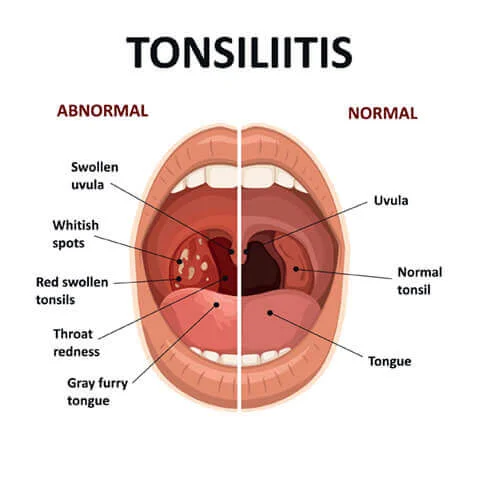
Tonsillitis diagram: inflamed tonsils at the back of the throat
Tonsillitis: inflamed tonsils on both sides of the throat.

Laryngitis

The larynx allows air to pass in and out of the lungs while preventing solids (food) and liquids from entering the lungs. The larynx also contributes to voice production through the vocal cords.

Laryngitis is an inflammation of the larynx. It is characterised by hoarseness, coughing, breathing difficulties in some children and, occasionally, loss of the voice. Besides infection, laryngitis can be caused by acid reflux, nodules, polyps or nerve damage in the vocal cords.

Laryngitis usually resolves on its own within two weeks with the help of increased air humidity, drinking plenty of fluids and resting the voice, whereas chronic laryngitis may need surgical treatment.

Pharyngitis

The pharynx is the tissue behind the mouth and the soft palate and acts as a passage for food and liquids to enter the oesophagus and for air to enter the lungs. An inflammation of the pharynx is called pharyngitis.

Painful swallowing is the most common symptom. Pharyngitis may also occur together with laryngitis. Again, the inflammation usually resolves on its own with rest, fluids and air humidity or symptomatic therapy.

Epiglottitis

The epiglottis is a flap of tissue at the base of the tongue that prevents food from entering the airway during swallowing. Epiglottitis occurs when this tissue becomes inflamed and infected.

Swelling of the epiglottis can obstruct the airway and result in a medical emergency. In addition to infections, epiglottitis can be caused by chemicals, severe heat injury or trauma.

Voice

Hoarseness


Abnormal changes in the voice are referred to as "hoarseness". When the voice is hoarse, it may sound breathy, raspy or strained, or show changes in volume or pitch (depending on how high or low the voice is).

How the voice is produced

Voice changes are related to disorders of the sound-producing parts (the vocal folds) of the voice box (larynx). During breathing, the vocal folds remain apart. When we speak or sing, they come together and, as air leaves the lungs, they vibrate and produce sound. Swelling or lumps on the vocal folds prevent this vibration, changing the quality, volume and pitch of the voice.

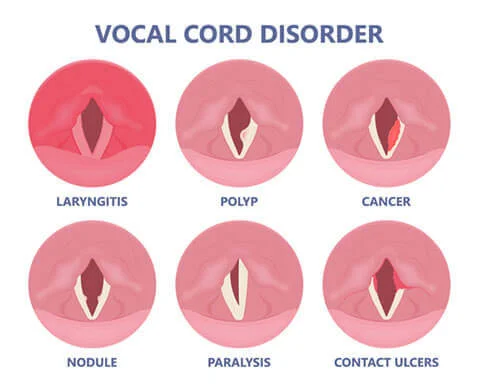
Chart of vocal cord disorders: nodules, polyps and cysts on the vocal folds
Vocal cord disorders: nodules, polyps and cysts prevent the folds from vibrating.

What are the causes?

Acute laryngitis

The most common cause is acute laryngitis (swelling of the vocal folds), which occurs during a common cold, a viral infection of the upper respiratory tract or as a result of voice strain. Serious injury to the vocal folds can result from intensive use of the voice during an episode of acute laryngitis.

Voice misuse

Speaking in noisy environments, overuse of the voice, using the telephone with the handset cradled on the shoulder, using an inappropriate pitch (too high or too low) when speaking, and not using amplification when speaking in public.

Benign vocal cord lesions

Prolonged hoarseness can occur when you use your voice too much or too loudly over long periods of time. These habits can lead to nodules, polyps and cysts. Vocal nodules (singer's nodules) are callus-like growths on the vocal folds. Polyps and cysts of the vocal folds also occur in people who misuse their voice, but they can appear in those who do not as well.

Vocal fold haemorrhage

If you experience a sudden loss of voice after shouting or other heavy voice use, you may have developed a vocal fold haemorrhage. A vocal fold haemorrhage occurs when one of the blood vessels on the surface of the vocal fold ruptures and the soft tissue fills with blood. It is considered a vocal emergency and must be treated with absolute voice rest and examination by an ENT specialist (ear, nose and throat doctor).

Gastro-oesophageal reflux (GERD)

One possible cause of hoarseness is gastro-oesophageal reflux, when stomach acid rises into the swallowing tube (oesophagus) and irritates the vocal folds. Other typical symptoms of GERD include heartburn and regurgitation. Usually, the voice is worse in the morning and improves during the day. These patients may have the sensation of a lump or mucus in the throat and feel an excessive need to clear it.

Laryngopharyngeal reflux (LPRD)

If reflux reaches beyond the upper sphincter and into the back of the throat, it is called LPRD rather than GERD. The structures in the throat (the pharynx, larynx and lungs) are far more sensitive to stomach acid and digestive enzymes, so smaller amounts of reflux in this area can cause more damage. Many patients with LPRD have no heartburn or other classic GERD symptoms. It is often called "silent reflux".

Smoking

Smoking is another cause of hoarseness. Because smoking is the leading cause of throat cancer, smokers who become hoarse should see an ENT specialist.

Neurological diseases or disorders

Hoarseness can also occur in people with neurological conditions such as Parkinson's disease or stroke, or it may be a symptom of spasmodic dysphonia, a rare neurological disorder that usually affects only the voice but sometimes also affects breathing. A paralysed vocal fold may be the cause of a weak voice. If hoarseness lasts longer than three months and other causes have been ruled out, a neurologist may be helpful for your diagnosis.

Other causes

These include allergies, thyroid problems, trauma and, occasionally, menstruation. Very serious conditions, such as cancer of the larynx, can also cause hoarseness, which is why it is important that chronic hoarseness is assessed promptly by an ENT specialist.

Assessment and treatment of hoarseness

Hoarseness caused by a cold or the flu can be assessed by family doctors, paediatricians and internists who have learned how to examine the larynx. Voice problems are often best managed by a team of professionals who know and understand how the voice works. These professionals are ENT specialists, speech and language pathologists, and teachers of singing, acting and public speaking. Vocal nodules, polyps and cysts are usually treated with a combination of microsurgery and voice therapy.

How is hoarseness assessed?

ENT specialists will take a complete history of the patient's hoarseness and general health. They will then assess the voice and carry out a full examination of the ears, nose and throat. This includes examining the vocal folds with laryngoscopy. Laryngoscopy may be suggested by the ENT specialist at any point during an assessment for hoarseness, but if the hoarseness lasts longer than three weeks, the assessment should be carried out immediately when a serious underlying cause is suspected.

Doctors usually view the vocal folds either with a mirror placed at the back of the throat, or with a very small rigid or flexible endoscope passed through the nose or mouth to see the vocal folds. Video endoscopy or stroboscopy (slow-motion assessment) can also help with the analysis. These procedures are well tolerated by most patients.

In some cases, special tests designed to evaluate the voice may be recommended. These measure voice irregularities, how the voice sounds, airflow and other characteristics that are useful in making a diagnosis and guiding treatment.

How are voice disorders treated?

Treatment of hoarseness depends on the cause. Many common causes of hoarseness can be treated simply by resting the voice or modifying the way it is used. An ENT specialist can make certain recommendations about voice use behaviour, refer the patient to other members of the voice team and, in some cases, recommend surgery if a lesion such as a polyp is identified. Not smoking and avoiding second-hand smoke is recommended for all patients. Drinking fluids and taking medication to thin the mucus may help.

How to prevent hoarseness

Specialists in speech and language pathology (voice therapists) are trained to help patients modify their behaviour in order to help eliminate certain voice disorders. Patients who have developed bad habits, such as smoking or overusing the voice by shouting, benefit most from this conservative approach. A speech and language pathologist can teach patients to change the way they produce speech, improve the sound of the voice and resolve problems such as vocal nodules. When a patient's problem is specifically related to singing, a singing teacher can help improve the patient's singing technique.

When should I see an ENT specialist?

  • If hoarseness lasts longer than three weeks, especially if you smoke
  • If you do not have a cold or the flu
  • If you are coughing up blood
  • If you have difficulty swallowing
  • If you feel a lump in your neck
  • If you notice severe loss of or changes in your voice lasting more than a few days
  • If you have pain when speaking or swallowing
  • If breathing difficulty accompanies the change in your voice
  • If your hoarseness interferes with your daily life
  • If you are a vocal performer and are unable to perform

Preventive advice

  • If you smoke, stop
  • Avoid agents that dehydrate the body, such as alcohol and caffeine
  • Avoid second-hand smoke
  • Stay hydrated: drink plenty of water
  • Humidify your home
  • Watch your diet: avoid spicy foods
  • Try not to use your voice for too long or too loudly
  • Use a microphone where possible in situations where you have to project your voice
  • Seek professional voice training
  • Avoid speaking or singing when your voice is injured or hoarse

Ear

Ear infections


The ear consists of three parts: the outer ear, the middle ear and the inner ear. Each of these areas is susceptible to infection, which can be painful.

Illustration of the structure of the ear: outer, middle and inner ear
The three parts of the ear: outer, middle and inner. Each one can become infected.

Young children are more prone to earache. While most earaches resolve on their own within a few days, you should have a physical examination to determine the type of infection, to prevent it from spreading and to receive treatment that helps relieve the pain.

Outer ear infection (otitis externa)

Also known as "swimmer's ear", outer ear infections result from inflammation, often bacterial, in the outer ear. They generally occur when water, sand or dirt enters the ear canal. Humidity in the air or swimming makes the ear more susceptible to this type of infection.

Symptoms include severe pain, itching, redness and swelling of the outer ear. There may also be fluid discharge. The pain is often worse when chewing or when the ear is pulled. To reduce the pain and prevent other long-term effects on the ear, be sure to consult a doctor.

Complications of untreated otitis externa may include hearing loss, recurrent ear infections and damage to bone and cartilage. Typically, your doctor will prescribe treatment that stops bacterial growth. In more severe cases, the doctor may also prescribe an antibiotic and pain medication. Most outer ear infections resolve within seven to 10 days.

Middle ear infection (otitis media)

Middle ear infections can be caused by a bacterial or viral infection. These infections can be triggered by airborne or food allergies, infections elsewhere in the body, nutritional deficiencies or blockage of the Eustachian tube.

In chronic cases, a thick, glue-like fluid may drain from the middle ear. Treatment depends on the cause of the infection and ranges from ear drops to the surgical insertion of a tube to drain the fluid from the middle ear, or an adenoidectomy.

Inner ear infection (otitis interna)

Also known as labyrinthitis, inner ear infections are most often caused by other infections in the body, particularly infections of the sinuses, throat or teeth.

Symptoms include dizziness, fever, nausea, vomiting, hearing loss and ringing in the ears. Always seek medical care if you think you may have an inner ear infection.

Balance

Dizziness


The inner ear serves two purposes: hearing and balance. There are mechanisms in the ear that continuously inform the brain about your position, your orientation in space and your movement, in order to keep you balanced.

A false sensation of spinning, known as vertigo, can occur when the signal to the brain is blocked or triggered incorrectly. Besides the sensation of dizziness, symptoms may include headache, vomiting, sensitivity to bright light, blurred vision, ringing in the ears, earache, facial numbness, eye pain, motion sickness, confused thinking, fainting and clumsiness.

Dizziness can also be a symptom of a more serious medical problem, such as high or low blood pressure, heart problems, stroke, a tumour, medication side effects or metabolic disorders. For this reason, you should always seek medical care if you experience persistent or recurrent dizziness.

Common causes of dizziness

Acoustic neuroma

An acoustic neuroma is a benign growth on the nerve that connects the inner ear to the brain. An MRI is ordered to diagnose this tumour, particularly if hearing is asymmetrical between the ears.

Benign paroxysmal positional vertigo (BPPV)

BPPV occurs when tiny calcium crystals in the ear become loose and start to move into the wrong part of the ear. It is characterised by sudden, brief bursts of dizziness, most often occurring as a result of head movement. There is no known cause for BPPV. It usually resolves on its own within a few days, but it can also be improved with an Epley manoeuvre (a repositioning procedure) that your doctor can perform in the clinic.

Inner ear inflammation

Dizziness can be a symptom of an inner ear infection. This is usually due to a viral infection of the upper respiratory tract (viral neuritis) and can sometimes also affect hearing (labyrinthitis). Steroids are sometimes prescribed to reduce the inflammation, which should then improve the symptoms of dizziness and/or hearing loss.

Ménière's disease

Ménière's disease is characterised by long episodes of dizziness, lasting from 30 to 60 minutes or longer. It is accompanied by symptoms such as ringing in the ear, hearing loss and vertigo. There is no known cause or cure for Ménière's disease, although medication and behavioural changes can help reduce the severity of the symptoms.

Migraine

Some migraines (vestibular migraines) can cause a feeling of imbalance and vertigo. This may be accompanied by sensitivity to light and/or sound, ringing in the ears or hearing loss. Migraine-related vertigo can occur together with or separately from migraine headaches.

Nose

Nasal breathing problems


The nose performs three main functions: it warms, humidifies and filters the air as it passes into the body. Breathing problems can affect one or more of these functions.

Breathing problems can be temporary or chronic, mild or severe, but they usually increase with age. X-rays and CT scans may also be taken to obtain a visual picture of your airways.

The most common breathing problems

Allergy

When an allergen enters the body, the immune system begins to counteract its effects. In most cases, the immune system produces histamine, which causes the symptoms commonly associated with allergies and hay fever: headache, sneezing, watering or itchy eyes, nasal congestion and a scratchy throat. Allergens range from pollen to environmental and chemical pollutants. Smoking can also contribute to a blocked nose.

To treat allergies, most people need to reduce their exposure to the allergen and take medication, often antihistamines and nasal decongestants. In more severe cases, allergy injections or allergy drops may be needed to build up the body's immune response to the allergen over time.

Deviated septum

The septum is the vertical structure that separates the two nasal passages. When the septum is crooked or bent, it is called a deviated septum, which can obstruct the airflow through the nose. If the narrowing is significant, an outpatient surgical procedure can straighten the septum and open the nasal airways.

Environmental factors

Mould, dust and dry air are the most common culprits of environmentally triggered allergies. These can be assessed by your doctor through a physical examination and skin tests. If the allergic response is severe, your doctor may recommend allergy injections or allergy drops to build up immunity to the allergens and relieve your symptoms.

Sinusitis

Sinusitis is an inflammation of the sinus tissue behind the upper cheeks, on both sides of the nose, between the eyes and above the eyes. It is characterised by congestion and a feeling of pressure, sometimes in response to moving up and down. Sinus pressure can also cause watering eyes.

Many over-the-counter medicines are sufficient to treat mild sinusitis. In more serious cases, prescription medication may be required to relieve the pain and pressure and to open the nasal passages. Occasionally, surgery is needed to remove chronically inflamed sinus tissue.

Do you need an ENT consultation?

Book an appointment or call us: Monday to Friday 10:00–18:00, Saturday 9:00–12:00.