
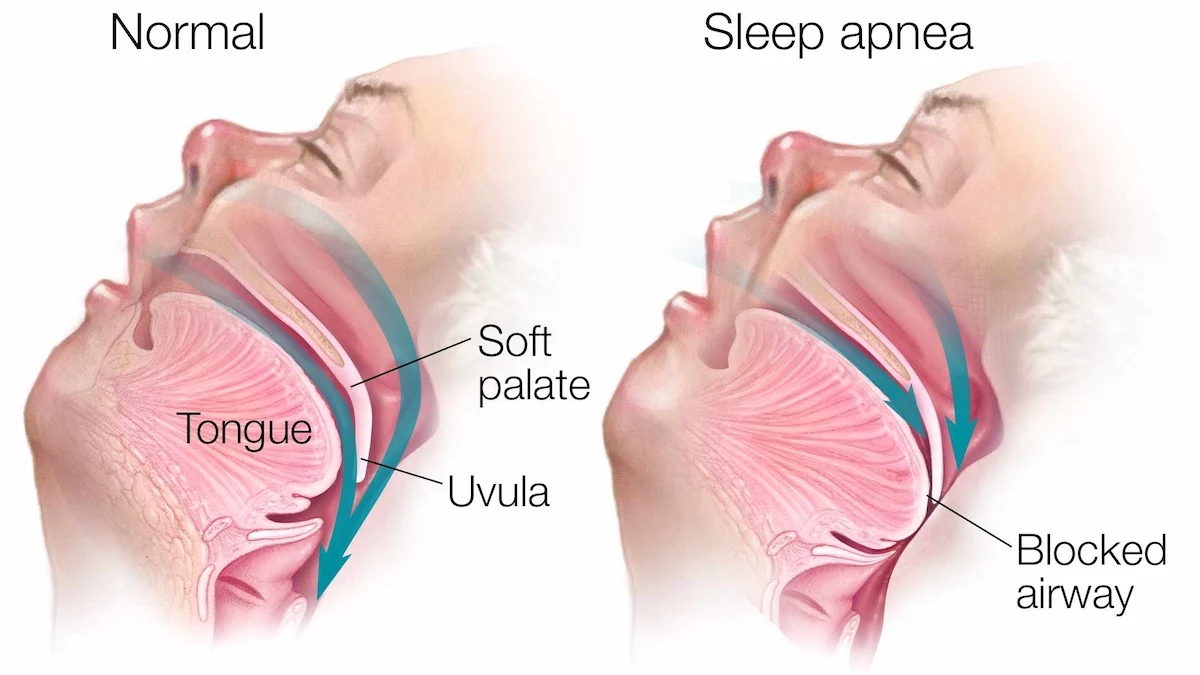
Snoring is often treated as a family joke or as a minor nuisance that disturbs a partner's sleep. In a number of cases, however, it is the outward sign of a far more serious problem: obstructive sleep apnea — a condition in which the airway becomes partially or completely blocked during sleep, causing repeated interruptions of breathing. This article explains how it is recognised, why it needs to be treated and what an otorhinolaryngology specialist (ENT — ear, nose and throat) can do for you.
What is sleep apnea?
The word apnea means a pause in breathing. During sleep, the muscles of the throat relax naturally. When the structures of the upper airway — the soft palate, the tonsils, the base of the tongue, the pharyngeal wall — are excessive in volume or their muscle tone is weakened, they can collapse onto the air passage and narrow it.
When the narrowing is partial, air passes with difficulty and makes the tissues vibrate, which we perceive as snoring. When the blockage is complete, breathing stops for several seconds. Blood oxygen levels fall, the brain responds with a brief (often unconscious) arousal, the muscles contract and breathing resumes — frequently with a gasp or a loud noise. A person with apnea may go through this cycle dozens of times within a single hour without remembering any of it in the morning.
The main types
- Obstructive sleep apnea (OSA) — the most common form, caused by mechanical blockage of the airway.
- Central apnea — rarer, occurring when the brain fails to send the proper signal to breathe. It is most often linked to neurological or cardiac disease.
- Mixed form — a combination of the two.
In ENT practice, the obstructive form is the one we encounter most often, since its causes lie precisely in the nose, the throat and the structures of the pharynx.
Signs that should not be ignored
Sleep apnea is frequently diagnosed late, because the main symptoms occur while the patient is asleep. Many patients come for a consultation precisely because a partner or a family member has noticed something unusual.
Signs during the night
- Loud, persistent snoring, often interrupted by silence and then by a noisy gasp.
- Pauses in breathing observed by others.
- Restless sleep, frequent movement, repeated awakenings.
- Frequent urination during the night.
- Night sweats, a dry mouth or a sore throat in the morning.
Signs during the day
- Persistent fatigue, regardless of the hours spent in bed.
- Marked sleepiness — at work, while reading, even while driving.
- Morning headaches.
- Difficulty concentrating, forgetfulness, reduced performance.
- Irritability, mood changes, sometimes depressive symptoms.
- Reduced sexual desire.
In children the picture may look different: instead of sleepiness, there is hyperactivity, learning difficulties, mouth breathing, night-time snoring and sometimes delayed growth. In this age group, enlarged tonsils and adenoids are among the most frequent causes.
Why sleep apnea is not only a sleep problem
Interrupted breathing does more than exhaust the patient — it places a strain on the cardiovascular system. Repeated drops in oxygen and frequent arousals activate the sympathetic nervous system, raise blood pressure and create chronic stress for the heart.
Untreated obstructive sleep apnea is associated with a higher risk of:
- arterial hypertension that is difficult to control;
- cardiac arrhythmias;
- coronary artery disease and heart failure;
- stroke;
- insulin resistance and type 2 diabetes;
- traffic and workplace accidents as a result of sleepiness.
For this reason, sleep apnea should not be seen as a cosmetic or acoustic annoyance, but as a medical condition that requires assessment.
Contributing factors
Several factors increase the likelihood of obstructive apnea:
- Excess weight, particularly fat deposits in the neck region.
- Airway anatomy — an elongated soft palate, a large uvula, enlarged tonsils, a bulky tongue.
- Nasal obstruction — a deviated nasal septum (the wall separating the two nasal cavities), enlarged turbinates, polyps, chronic allergies, all of which force breathing through the mouth.
- A small or set-back lower jaw (retrognathia) and other structural variations of the skull and throat.
- Age — muscle tone declines over the years.
- Sex — more common in men, while in women the risk increases after menopause.
- Alcohol, sedatives and tobacco, which relax the muscles and irritate the mucosa.
- Hypothyroidism and other endocrine conditions.
How it is diagnosed
The diagnosis is not made simply from a description of snoring. It requires a structured assessment.
1. Medical history and questionnaires
The specialist asks about your sleep schedule, snoring, daytime sleepiness, accompanying conditions and the medication you take. Information from a partner or family member is extremely valuable. Standardised questionnaires are also used to assess sleepiness and risk.
2. The ENT examination
The nose, mouth, throat and neck are examined in order to identify the points of narrowing: a deviated septum, enlarged turbinates, large tonsils, a low-lying palate, a bulky tongue base. In many cases flexible endoscopy is used — a thin tube with a camera that allows a direct view of the upper airway. This examination matters because it shows where exactly the blockage occurs, which is decisive information for the treatment plan.
3. The sleep study
Objective confirmation is obtained through respiratory polygraphy or polysomnography — a recording of breathing, oxygen levels, pulse, body position and, in the full version, brain activity during sleep. These measurements yield the apnea-hypopnea index, which determines whether the condition is mild, moderate or severe. Without this step, treatment remains guesswork.
Treatment options
Treatment depends on the severity of the apnea, on the patient's anatomy and on any accompanying conditions. There is no single solution that suits everyone.
Behavioural and lifestyle measures
- Weight loss, where excess weight is present, has a direct effect on the space available in the airway.
- Avoiding alcohol in the evening hours.
- Stopping smoking.
- A regular sleep schedule.
- Positional therapy — for patients whose apnea occurs mainly while lying on the back.
These measures are essential, but on their own they are rarely sufficient in moderate and severe forms.
Positive airway pressure therapy (CPAP)
A CPAP device delivers air at mild pressure through a mask, keeping the airway open throughout the night. It is regarded as the standard treatment for moderate and severe forms. The main challenge is adaptation: the mask must be selected with care and the patient needs follow-up during the first weeks. Treating nasal obstruction at the same time often makes the device considerably easier to tolerate.
Oral appliances
These devices hold the lower jaw slightly forward, widening the space behind the tongue. They are used in mild and moderate forms, or when CPAP is not tolerated. They are made individually in cooperation with a dentist.
Surgical treatment
Surgery aims to remove the obstruction at the identified point of blockage. Depending on the case, it may include:
- correction of the nasal septum and reduction of the turbinates, to restore normal breathing through the nose;
- removal of polyps or treatment of chronic sinusitis;
- removal of the tonsils and adenoids — a particularly effective procedure in children;
- procedures on the soft palate and uvula to tighten and lift them;
- procedures at the base of the tongue, in selected cases.
The decision to operate is taken only after a full assessment, weighing the benefits, the risks and realistic expectations. In certain patients, surgery may not eliminate the apnea entirely, but it can make it possible for the patient to use CPAP comfortably.
When to seek a consultation
We recommend an assessment with an ENT specialist if:
- you snore loudly and regularly;
- family members have noticed pauses in your breathing during sleep;
- you wake up unrested, with a headache or a dry mouth;
- you experience daytime sleepiness that affects your work or your driving;
- you have hypertension that is difficult to control;
- your child snores, sleeps with an open mouth or has attention difficulties.
At RINO Clinic in Ferizaj, the assessment of a patient with suspected sleep apnea begins with a detailed medical history and an endoscopic examination of the upper airway, in order to define the further diagnostic and therapeutic plan.
Important note: the information in this article is educational in nature and does not replace a medical consultation. The diagnosis of sleep apnea and the choice of treatment must always be made by a specialist, following an individual examination. Please do not self-treat and do not stop prescribed medication without consulting your doctor.
Frequently asked questions
Does everyone who snores have sleep apnea?
No. Snoring can occur without any interruption of breathing — this is known as simple snoring. Nevertheless, loud and persistent snoring, especially when accompanied by daytime fatigue or by observed pauses in breathing, is reason enough for a specialist assessment. Only a sleep study can accurately distinguish simple snoring from apnea.
Can sleep apnea be cured through weight loss?
Weight loss can considerably reduce the severity of apnea, especially when excess weight is the main factor. In some patients with a mild form, the improvement can be substantial. However, when anatomical factors are also present — such as a deviated septum, large tonsils or an elongated palate — weight alone does not solve the problem and additional treatment is required.
Will I have to use CPAP for the rest of my life?
CPAP is a treatment that controls apnea for as long as it is used, but it does not remove the underlying cause. In some patients, weight loss or surgical correction of the obstructions can reduce the need for the device or allow lower pressures. Any decision to change or discontinue therapy is taken only after reassessment and a repeat sleep study.
How is sleep apnea treated in children?
In children, the most frequent cause is enlargement of the tonsils and adenoids. Their surgical removal often brings a marked improvement in breathing during sleep, in sleep quality and in daytime behaviour. Every case, however, requires an individual assessment by an ENT specialist, since allergies, weight and features of jaw structure may also play a role.
How long does a complete sleep apnea assessment take?
The first consultation with an ENT examination and endoscopy is usually completed within a single visit. The sleep study is carried out overnight and the results are interpreted afterwards. The treatment plan is then defined. The overall timeframe varies from case to case and depends on the need for additional examinations or consultations with other specialties, such as cardiology or endocrinology.